

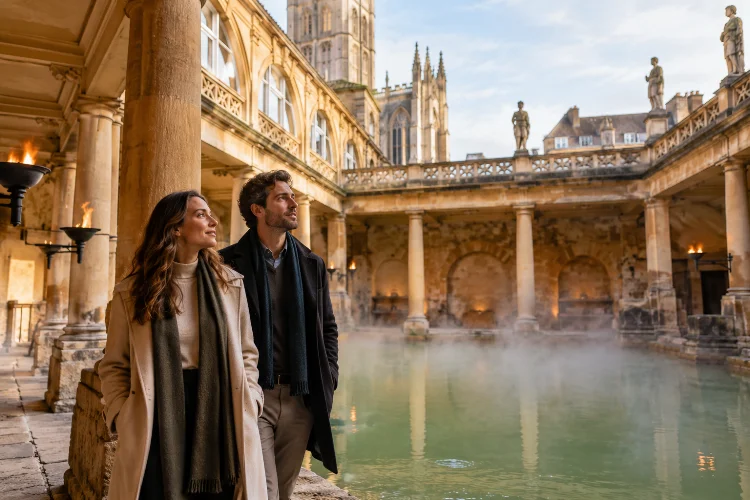
A countryside stay around Limpley Stoke does not have to mean choosing rural scenery over culture.
In fact, one of the biggest advantages of staying in this quiet corner of the Avon Valley is how easily you can combine wooded walks and river views with some of southwest England’s richest historical attractions.
The best cultural attractions to pair with a Limpley Stoke countryside stay range from Roman archaeology and medieval churches to Georgian townhouses, major art collections, landscaped estates, and one of England’s finest surviving medieval barns.
Bath provides the greatest concentration, while Claverton and Bradford-on-Avon add worthwhile alternatives outside the busiest city streets.
The smartest approach is not to squeeze everything into one exhausting day. Spend mornings enjoying Limpley Stoke, Freshford, or the Avon Valley, then choose one or two cultural sites for the afternoon.
That rhythm gives you the best of both worlds: rural calm when you want it and serious history, architecture, and art whenever you are ready to explore.
1. Start With the Roman Baths for the Region’s Deepest History
If you visit only one major attraction during your stay, the Roman Baths provides the clearest introduction to Bath’s origins.
The site preserves around 2,000 years of history around the city’s natural thermal springs.
Visitors can explore the Great Bath, Sacred Spring, Roman bathing rooms, archaeological collections, and evidence of the ancient settlement known as Aquae Sulis. The museum describes the complex as one of the world’s best-preserved Roman remains.
This pairs surprisingly well with Limpley Stoke.
Your morning might begin among woodland, stone cottages, and the Avon Valley before you travel into Bath and suddenly find yourself examining Roman engineering beneath the modern city. That contrast makes the history feel more dramatic than spending the entire trip inside an urban centre.
The Roman Baths are currently open daily through the autumn from 9 a.m. to 6 p.m., with last admission at 5 p.m., although seasonal hours should always be checked before travelling.
Allow at least 90 minutes rather than trying to rush through.
2. Explore Bath Abbey and More Than a Thousand Years of History
Step outside the Roman Baths and Bath Abbey is almost immediately in front of you.
A place of Christian worship has existed on the site for well over a thousand years. Bath Abbey records a Saxon convent by 675 AD, while King Edgar was crowned King of England there in 973. The present building incorporates centuries of later rebuilding and restoration.
The interior is particularly memorable for its fan-vaulted ceiling, stained glass, memorials, and spacious late-Gothic architecture.
It also provides an interesting historical connection with Limpley Stoke. Both places preserve strong evidence of Anglo-Saxon and medieval settlement, yet they developed at completely different scales—one as a major religious and urban centre, the other as a small Avon Valley community.
The Abbey remains an active church, so visiting access can occasionally change around services and events. Check the day’s schedule rather than assuming every part will always be open.
3. Experience Georgian Life Inside No.1 Royal Crescent
Bath’s Georgian architecture looks impressive from the street, but No.1 Royal Crescent lets you understand what life inside those elegant façades was actually like.
The museum occupies the first house constructed on the Royal Crescent and presents restored eighteenth-century interiors. Its interpretation covers both wealthy residents and the servants who worked below stairs, giving a more complete picture of Georgian domestic life.
That social dimension is what makes the museum especially worthwhile.
After wandering around Bath’s grand terraces, it can be easy to imagine Georgian life as an endless sequence of fashionable dinners and drawing rooms. The museum adds the labour, household management, routines, and inequalities behind that appearance.
Most visits take roughly one to one-and-a-half hours. In 2026, the museum is generally open Tuesday through Sunday, although there are seasonal closures and exceptions.
For architecture lovers, this is one of the strongest cultural choices to combine with a rural stay.
4. Spend a Slower Afternoon at the Holburne Museum
If your idea of culture leans more toward art than archaeology, head toward Great Pulteney Street and the Holburne Museum.
The Holburne describes itself as Bath’s first public art museum, combining historic collections with temporary exhibitions inside an elegant building at the edge of Sydney Gardens.
The location is part of its appeal.
Rather than spending another afternoon moving through crowded central streets, you can walk along Great Pulteney Street, visit the collection, and continue into the gardens afterward. It fits the slower pace of a countryside-based holiday particularly well.
As of October 2026, the museum is hosting Ancient Landscape, Modern Times: Eric Ravilious and the Artists of the Chalk Downs, alongside a contemporary exhibition by Richard Slee. Both run into January 2027.
Current general opening hours are 10 a.m.–5 p.m. Monday to Saturday and 11 a.m.–5 p.m. on Sundays and bank holidays.
It is an easy cultural stop without turning the whole day into intensive sightseeing.
5. Visit the American Museum & Gardens at Claverton
Not every cultural attraction needs to be in central Bath.
The American Museum & Gardens at Claverton Manor sits just outside the city and is particularly convenient for travellers already staying southeast of Bath around Limpley Stoke.
The museum combines American decorative arts and cultural history with landscaped gardens and countryside views.
Its setting makes it unusually compatible with a rural holiday.
You can spend part of the day indoors exploring collections, then continue outside through gardens rather than returning immediately to busy streets. The museum describes itself as only around ten minutes from central Bath and provides public transport access as well as visitor parking.
This is especially useful if you have already visited Bath’s headline attractions and want something less predictable.
It can also work well on a mixed-weather day because you are not entirely dependent on either indoor galleries or outdoor scenary.
6. Discover Medieval England at Bradford-on-Avon Tithe Barn
For a cultural outing that feels closer to Limpley Stoke’s rural character, head east toward Bradford-on-Avon.
Its Tithe Barn is one of the finest surviving medieval barns in England. English Heritage dates the great structure to the fourteenth century and highlights its original roof frame, substantial ashlar masonry, and connection with Barton Grange, once owned by Shaftesbury Abbey.
The building is approximately 51 metres long, making its vast timber interior particularly impressive when you step inside.
Unlike a formal museum filled with displays, much of the experience comes from the architecture itself.
The barn also sits beside the River Avon and close to the Kennet & Avon Canal, so it can be paired with a countryside walk rather than treated as a stand-alone attraction.
Entry is currently free, with regular opening listed as 10:30 a.m. to 4 p.m., although occasional events can cause closures.
For anyone staying in Limpley Stoke, this is one of the most natural cultural day trips.
7. Add the Victoria Art Gallery for an Easy City-Centre Culture Stop
Not every cultural attraction needs half a day.
The Victoria Art Gallery sits close to Pulteney Bridge and works well when you have already planned lunch, shopping, or architectural sightseeing in central Bath.
The gallery houses paintings, sculpture, and decorative arts, with works associated with artists including Thomas Gainsborough, Walter Sickert, Paul Klee, and Grayson Perry. The permanent Upper Gallery is free to enter, while temporary exhibitions may require tickets.
That makes it an excellent flexible option.
You can spend 30–60 minutes there without restructuring the rest of your itinerary. It is also useful when unpredictable weather makes a planned riverside walk less appealing.
Current 2026 opening is generally Tuesday through Sunday from 10:30 a.m. until 5 p.m., although hours can change.
For a countryside traveller who does not want every cultural visit to feel like a major expedition, this kind of compact gallery is particularly convienient.
How to Balance Culture With a Countryside Stay
The biggest mistake is trying to visit all these places in two days.
Instead, pair one major attraction with one lighter experience. The Roman Baths and Bath Abbey naturally fit together because they sit almost side by side.
No.1 Royal Crescent works well with a broader Georgian architecture walk, while the Holburne Museum combines easily with Great Pulteney Street and Sydney Gardens.
Save Bradford-on-Avon for a separate half-day that includes the Tithe Barn, canal, and riverside landscape.
The American Museum works best as a destination in its own right, particularly if you have access to a car or are comfortable using local transport.
Leave some mornings completely unscheduled too. A Limpley Stoke countrysdie stay loses much of its appeal if every sunrise is followed by a race toward another ticketed attraction.
The real luxury is having both options.
The best cultural attractions to pair with a Limpley Stoke countryside stay allow you to move naturally between rural England and some of the region’s richest heritage.
The Roman Baths and Bath Abbey reveal ancient and medieval Bath, while No.1 Royal Crescent brings Georgian society to life.
The Holburne and Victoria Art Gallery provide strong art collections, and the American Museum adds a more unusual cultural perspective outside the centre.
For something even closer to the surrounding landscape, Bradford-on-Avon’s medieval Tithe Barn is an excellent choice.
Rather than collecting attractions, build each day around one strong cultural experience and leave space for walking, lunch, or simply enjoying the Avon Valley.
Use Limpley Stoke as the quiet counterpoint to Bath’s museums and monuments, and the whole trip will feel far more balanced.
