

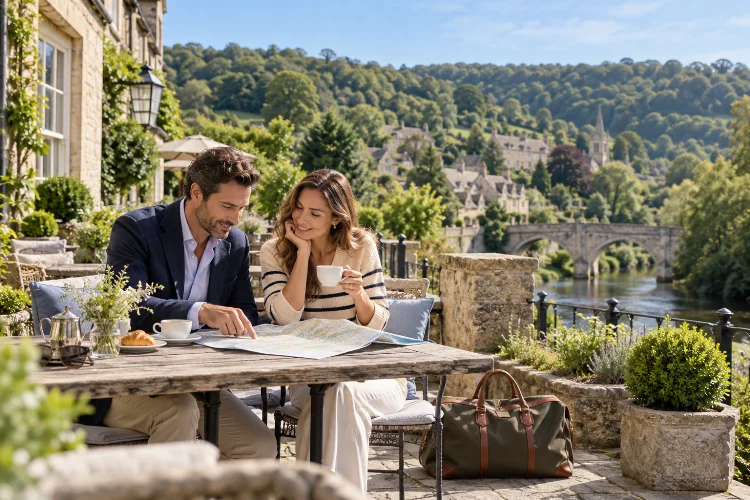
Combining a quiet Wiltshire village with one of England’s most elegant historic cities sounds ambitious for a single day, but Limpley Stoke and Bath complement each other surprisingly well.
The trick is not to treat them as two destinations that need to be hurried through. Instead, think of the day as a gradual transition.
Begin with woodland, limestone cottages, old lanes, and views across the Avon Valley, then move into Bath for Georgian architecture, Roman history, art, good food, and perhaps an evening soak in naturally heated water.
Knowing how to combine Limpley Stoke with a sophisticated day trip to Bath is mostly about pacing.
Limpley Stoke deserves a slow morning rather than a checklist, while Bath is better when you select two or three experiences instead of attempting every major attraction.
The connection is practical too. Nearby Freshford is served by rail and promoted by Visit Bath as a convenient gateway to the Limpley Stoke Valley, making a countryside-to-city itinerary possible without spending most of the day in a car.
Begin With a Quiet Morning in Limpley Stoke
Start the day around 8:30 or 9:00, when Limpley Stoke is still relatively peaceful.
The village occupies rising ground above the River Avon, with woodland surrounding parts of the settlement. Its history reaches back to Saxon times, while later cloth production encouraged development toward the river and the local mill.
Rather than immediately setting off on a long hike, spend the first hour simply exploring.
St Mary’s Church provides a natural historical anchor. From there, wander through the older lanes and notice how limestone houses, walls, greenery, and steep terrain combine to give the village its distinctive character.
The point is atmosphere rather than mileage.
A sophisticated itinerary usually feels better when it begins slowly. Coffee beforehand, comfortable walking shoes, and perhaps a camera are more useful than trying to complete a demanding countryside route before breakfast.
Add a Short Avon Valley Walk Before Leaving
Give yourself another 60–90 minutes for the countryside.
One good option is to walk toward Freshford, combining village lanes with field paths and viewpoints over the Limpley Stoke Valley. Freshford is particularly useful because it naturally moves your itinerary toward Bath rather than forcing you to return to your starting point.
Visit Bath recommends Freshford and Avoncliff for walking in the Limpley Stoke Valley, including routes that follow the River Avon through the surrounding countryside. Both villages also have rail connections toward Bath.
Keep the morning walk deliberately modest.
This is not the day to add a 15-mile trek if you also want to enjoy Bath properly. A couple of hours outdoors gives you enough contrast without arriving in the city muddy, hungry, and exhausted.
If rainfall has been heavy, choose higher village paths rather than relying entirely on low riverside ground. Good footwear remains worthwhile even on a relatively polished itineray.
Make the Transition to Bath Part of the Experience
One of the easiest ways to preserve the relaxed mood is to avoid driving into central Bath if you do not need to.
Freshford is described by Visit Bath as only a short rail trip outside Bath and forms part of the Heart of Wessex line serving the valley.
Walk or arrange local transport from Limpley Stoke toward Freshford, then continue by train to Bath Spa, checking the day’s live timetable before departure.
This creates a pleasing change in pace.
You move from footpaths and village streets onto a short train journey through the Avon Valley before emerging within walking distance of Bath’s historic core.
It also avoids spending valuable sightseeing time looking for central parking.
Pack lightly if possible. A compact backpack with a waterproof layer, water, and a change of socks is enough for the countryside section without making the afternoon feel like you are still on a hiking expedition.
Enter Bath Through Its Roman and Medieval Heart
Once in Bath, resist the temptation to immediately rush toward the Royal Crescent.
Begin around Abbey Church Yard instead. This puts the Roman Baths and Bath Abbey side by side, allowing you to experience two major stages of the city’s history within a remarkably compact space.
Bath’s significance goes well beyond attractive Georgian streets. UNESCO notes that Roman thermal remains form one of the fundamental elements of the city’s World Heritage importance, while eighteenth-century Palladian architecture later transformed Bath into a fashionable spa city.
The Roman Baths are currently open daily in the autumn from 9:00 a.m. until 6:00 p.m., with last admission at 5:00 p.m., although visitors should always confirm seasonal hours before travelling.
Allow roughly 90 minutes if you decide to go inside.
If Roman history is not your priority, visit Bath Abbey instead. Normal visiting hours vary by day and can change around services or special events, so its official schedule is worth checking beforehand.
Plan a Proper Lunch Instead of Eating on the Run
A sophisticated day trip benefits from one substantial pause.
Bath has enough cafés, restaurants, tearooms, and hotel dining rooms that lunch can become part of the experience rather than an interruption between attractions.
Choose somewhere around the Abbey Quarter, Pulteney Bridge, or Great Pulteney Street depending on where you want to spend the afternoon.
Do not overcomplicate it.
A table-service lunch of around an hour gives your legs a break after the morning walk and prevents the common day-trip mistake of surviving on snacks while trying to see everything.
For a historically themed alternative, the Roman Baths promotes experiences associated with the adjacent Pump Room, whose Georgian social history makes it particularly fitting for a more refined visit.
Booking ahead is sensible on weekends and during busy travel periods.
This is one part of the schedule where spending slightly longer can actually improve the rest of the day.
Walk Bath’s Most Elegant Georgian Route
After lunch, make architecture the focus.
Start around Pulteney Bridge. Designed by Robert Adam in 1769, the bridge is notable for having shops running across both sides of its span and remains one of Bath’s defining Georgian landmarks.
From there, cross toward Laura Place and continue along Great Pulteney Street.
The long, symmetrical street offers one of the clearest demonstrations of Bath’s Georgian ambition. Visit Bath describes it as the city’s grandest thoroughfare, leading directly toward the Holburne Museum.
This walk works especially well after Limpley Stoke.
In the morning, limestone buildings appear organically among slopes, lanes, and woodland. In Bath, similar warm stone is used to create formal terraces, monumental façades, and carefully controlled urban perspectives.
The contrast makes both destinations more interesting when experienced on the same day.
Take your time around this neigbourhood. A slower architectural walk feels much more sophisticated than racing between photo locations.
Choose One Cultural Stop, Not Three
By mid-afternoon, choose a single museum or cultural experience.
The Holburne Museum is particularly convenient because it sits at the end of Great Pulteney Street. It is Bath’s first public art museum and combines collections and temporary exhibitions with an elegant historic setting beside Sydney Gardens.
As of October 2026, it is generally open Monday to Saturday from 10:00 a.m. to 5:00 p.m. and Sundays and bank holidays from 11:00 a.m. to 5:00 p.m., with final admission at 4:30 p.m. Current exhibitions should be checked before visiting.
Alternatively, make the Roman Baths your main paid attraction and keep the rest of the afternoon outdoors.
What you should avoid is buying tickets for several major sites simply because they are nearby.
Bath rewards attention. One museum explored properly, followed by a leisurely architectural walk, usually creates a better memory than three hurried admissions.
Save the Royal Crescent and Circus for Late Afternoon
Late afternoon is a good time to head west through Bath toward The Circus and Royal Crescent.
These landmarks demonstrate another side of Georgian urban planning. UNESCO specifically highlights Bath’s eighteenth-century architecture and the ambition to combine buildings and landscape into a harmonious spa city.
Walking rather than using tranport allows the city to unfold gradually.
Move from tighter streets into the geometry of The Circus, then continue toward the sweeping façade and open lawn of the Royal Crescent.
You do not necessarily need another attraction here. Simply walking through the area, noticing façades, doorways, columns, and the relationship between architecture and green space can be enough.
This is also when Bath often begins to feel less rushed as daytime visitors start dispersing.
If photography matters to you, softer late-afternoon light tends to be much kinder to Bath’s honey-coloured stone than harsh midday sun.
Finish With Thermal Water or a Riverside Evening
For the final part of the day, choose between relaxation and another gentle walk.
Thermae Bath Spa offers the most obvious indulgent finale. Its main spa uses Bath’s naturally warm mineral-rich waters, and entry is restricted to guests aged 16 and over, while treatments have a minimum age of 18.
Because facilities, sessions, and occasional closures can change, reserve in advance and check current conditions on the day.
If a spa visit feels too structured, keep the evening outdoors instead.
Return toward Pulteney Bridge and walk along the river. Parade Gardens is now free to enter and offers particularly good views toward Pulteney Bridge and the weir.
This gives the day a neat symmetry.
You began beside the Avon in a rural valley and finish beside the same river in one of Britain’s most architecturally celebrated cities – two landscapes linked by water but shaped in completely different ways.
Keep the Day Selective Rather Than Overplanned
The difference between a rushed Bath excursion and a sophisticated one is usually restraint.
Your morning might contain Limpley Stoke, a countryside walk, and Freshford. Your afternoon could reasonably include one historic attraction, lunch, Pulteney Bridge, Great Pulteney Street, one museum or the Royal Crescent, followed by a spa session or riverside walk.
That is already a full day.
Trying to add Bradford-on-Avon, several museums, extensive shopping, a long canal walk, and multiple formal meals will usually destroy the relaxed atmosphere.
Book only the experiences that genuinely require a timed reservation. Leave the rest flexible enough for an unexpectedly beautiful viewpoint, a longer lunch, or an extra half-hour wandering through a Georgian street.
Sophistication is partly about having enough time to enjoy where you are.
Learning how to combine Limpley Stoke with a sophisticated day trip to Bath is really about creating contrast without creating stress.
Begin slowly among the wooded slopes and historic lanes of the Avon Valley, walk toward Freshford, and use rail to make the transition into Bath feel effortless.
Once there, choose quality over quantity. Explore the Roman or medieval centre, enjoy a proper lunch, follow Pulteney Bridge toward Great Pulteney Street, and select one cultural experience before finishing among Georgian architecture or warm thermal waters.
The two places work beautifully together precisely because they are different.
Limpley Stoke provides silence, landscape, and rural heritage; Bath adds art, architecture, food, and urban elegance. Give each enough time, and the resulting day feels far richer than visiting either one in isolation.
