

Few places make it as easy to move between rural English history and major urban heritage as the Avon Valley between Limpley Stoke and Bath.
In the morning, you can wander through a small village shaped by Saxon settlement, medieval cloth making, old stone houses, and a dramatic valley landscape.
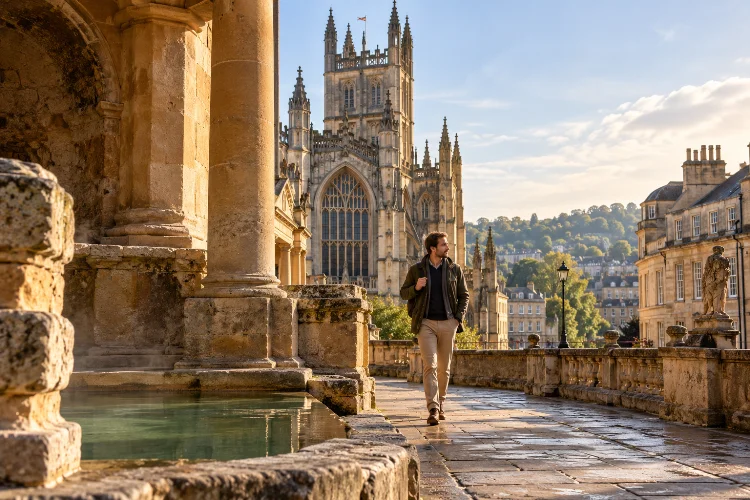
A short journey later, you can be standing beside Roman baths, a medieval abbey, and some of Britain’s most celebrated Georgian architecture.
Knowing how to plan a heritage-focused day between Limpley Stoke and Bath is mostly about resisting the temptation to see too much. The two destinations contain centuries of history, so a good itinerary should connect periods rather than collect landmarks.
Start with Limpley Stoke’s quieter story, move through nearby Freshford, then let Bath provide the grand finale. Freshford is particularly useful because Visit Bath places it around nine minutes from Bath by train.
Done well, the day becomes a journey from Saxon countryside to Roman and Georgian city.
Begin the Morning With Limpley Stoke’s Saxon Landscape
Start around 8:30 or 9:00 a.m. and give Limpley Stoke roughly an hour before travelling onward.
The village’s history is much older than its peaceful modern appearance suggests. Wiltshire’s community history records Limpley Stoke as part of the Saxon Hundred of Bradford.
The original settlement, known as Hanging Stoke, stood around the area east and south of today’s Church of St Mary.
That makes the church area the logical starting point. Instead of simply photographing old buildings, look at how the settlement fits into the landscape.
Limpley Stoke rises from the Avon Valley, while woodland and steep slopes frame the village. Those geographical features influenced everything from settlement patterns to later transport routes.
The original village was badly affected by the Black Death of 1348-49. A newer settlement subsequently developed farther north, partly because cloth weaving and river-powered industry were becoming increasingly important.
Even a short morning walk therefore covers several centuries of rural history.
Follow the Story From Church to Cloth Village
After visiting the older church area, continue toward Middle Stoke.
This part of the village reveals how economic activity reshaped rural settlement. By around 1500, a fulling mill was providing employment, while weavers’ cottages had been built for people connected with textile production.
Local businesses including an inn, bakery, and cider house later developed around this newer centre.
That is an important detail because it changes how you read the village.
The cottages were not simply picturesque rural homes. They belonged to a working landscape where the River Avon supplied power and local families earned their living from wool, brewing, farming, and associated trades.
Later landowners and clothiers encouraged development toward the river and mill, while larger houses reflected the wealth generated by commerce.
Spend perhaps 30 minutes walking rather than attempting a complicated hike. The aim is to understand the village before moving into Bath’s much larger historical story.
Use Freshford as the Transition Into Bath
Late morning is a good time to leave the rural valley behind.
Nearby Freshford works especially well as a gateway because it keeps the journey tied to the historical landscape rather than turning the middle of the day into a long driving exercise.
Visit Bath describes Freshford as sitting within the Limpley Stoke Valley and approximately nine minutes from Bath by train.
That short journey creates a surprisingly effective transition.
One moment you are surrounded by fields, village houses, and wooded slopes; shortly afterward, you arrive close to the centre of one of Britain’s most important historic cities.
Check the current rail timetable before travelling rather than building the day around assumed departure times. Services and engineering schedules can change, especially on weekends.
Try to arrive in Bath around 11:00 or 11:30. That gives you enough time for the main heritage attractions without turning the afternoon into a race.
Make the Roman Baths Your Main Historic Attraction
Once in Bath, head first toward Abbey Church Yard.
The Roman Baths should be the day’s major ticketed attraction because they provide the deepest chronological contrast with Limpley Stoke.
UNESCO describes Bath as a city founded by the Romans around natural thermal springs in the first century AD, with the baths and Temple of Sulis Minerva forming a central part of its outstanding historical significance.
Allow about 90 minutes to explore rather than trying to rush through.
As of October 2026, the Roman Baths are open daily from 9:00 a.m. until 6:00 p.m., with last admission at 5:00 p.m. Autumn opening hours apply until 31 October.
Inside, the archaeological remains make Bath’s ancient landscape much easier to understand. The city’s hot springs were not merely a curiosity; they determined why a significant Roman religious and bathing complex developed here.
After the quieter rural heritage of Limpley Stoke, the scale of Roman Bath feels especially impressive.
Pair the Roman Baths With Bath Abbey
Bath Abbey stands only a short distance away, making it the easiest second major heritage stop.
This is where the day’s timeline becomes particularly satisfying. You have already encountered Saxon history around Limpley Stoke, followed it into Roman Bath, and can now return to the medieval period in a dramatically different setting.
Bath Abbey preserves a long religious history, and its present building contains features spanning different centuries. The Abbey also recalls the coronation of King Edgar on the site in 973, providing another connection with Anglo-Saxon England.
Current standard visiting hours through early 2027 are generally 10:00 a.m.-5:30 p.m. Monday to Friday, 10:00 a.m.-6:00 p.m. Saturday, and more limited hours on Sunday. Because it is an active church, closures for services and special events can occur.
Allow 30–45 minutes unless you are taking a tower tour or exploring in greater depth.
Stop for Lunch Before Entering Georgian Bath
By this point, heritage fatigue can become very real.
Take a proper lunch break rather than eating while walking between attractions. Somewhere around Abbey Quarter or the streets leading toward Pulteney Bridge works well because you can continue naturally into the Georgian section afterward.
The pause is useful for more than food.
Roman archaeology and medieval churches require concentration, and Bath’s Georgian city deserves fresh attention rather than becoming background scenary.
UNESCO identifies Bath’s eighteenth-century redevelopment as one of the city’s defining achievements. Georgian planners created interconnected terraces, crescents, squares, and streets designed to combine monumental architecture with the surrounding landscape.
That makes the afternoon less about entering museums and more about walking through the city itself.
Walk From Pulteney Bridge Into Georgian Bath
Begin the architectural section at Pulteney Bridge.
Designed by Robert Adam and built in 1769, the bridge is unusual because shops run across its full span on both sides. Visit Bath describes it as one of the city’s most photographed Georgian landmarks.
Cross the bridge and spend time around the surrounding streets rather than heading immediately toward another admission queue.
From here, you can build a gradual route through the Georgian city, taking in classical façades, terraces, squares, and larger planned spaces.
The contrast with Limpley Stoke is especially interesting.
Both places use the warm stone associated with the Bath region, yet they use it in completely different ways. Limpley Stoke’s buildings adapt to steep rural terrain, while Georgian Bath turns stone into ordered façades and carefully staged urban perspectives.
That architecural contrast is one of the strongest reasons to visit both places on the same day.
Finish With the Circus and Royal Crescent
Make the western Georgian city your final major heritage zone.
The Circus and Royal Crescent represent the ambitious eighteenth-century planning that helped establish Bath as a fashionable spa destination.
UNESCO specifically highlights the city’s crescents, terraces, and squares as examples of architecture being integrated with landscape rather than treated as isolated buildings.
Walk this section rather than using taxis between landmarks.
The gradual movement from narrow central streets into broader Georgian spaces is part of the experience. It also mirrors the morning in Limpley Stoke, where landscape and settlement are equally difficult to seperate.
If you still have energy, allow time simply to sit near the Royal Crescent rather than adding another museum.
A heritage-focused day does not need to include every historic building. Seeing fewer places with enough time to understand them usually creates a stronger sense of the area’s history.
Keep the Itinerary Realistic
A workable day might begin with Limpley Stoke from roughly 8:30–10:00, followed by the journey through Freshford toward Bath.
Use late morning for the Roman Baths and Bath Abbey, then break for lunch around 1:30. Spend the afternoon walking through Georgian Bath, including Pulteney Bridge, The Circus, and Royal Crescent.
That already covers Saxon, medieval, Roman, industrial, and Georgian heritage without adding unnecessary detours.
Avoid squeezing Bradford-on-Avon, multiple museums, a canal walk, and a spa visit into the same itineray. Those are excellent experiences, but they deserve separate time.
Before leaving, confirm current attraction opening hours, railway services, and any Abbey closures. A little preparation protects the relaxed pace that makes this journey work.
Planning a heritage-focused day between Limpley Stoke and Bath works best when you treat the journey as a historical sequence rather than a sightseeing checklist.
Begin with Limpley Stoke’s Saxon settlement, church landscape, and cloth-making heritage before using nearby Freshford as the transition into Bath.
In the city, make the Roman Baths your main attraction, add Bath Abbey, then spend the afternoon experiencing Georgian architecture on foot.
Pulteney Bridge, The Circus, and Royal Crescent provide a strong finish without requiring another packed museum schedule. Most importantly, leave time to notice the connections.
Rural Limpley Stoke and monumental Bath may look very different, yet both were shaped by water, trade, landscape, and centuries of adaptation. Follow those threads, and one day can reveal an unusually rich slice of English history.
