

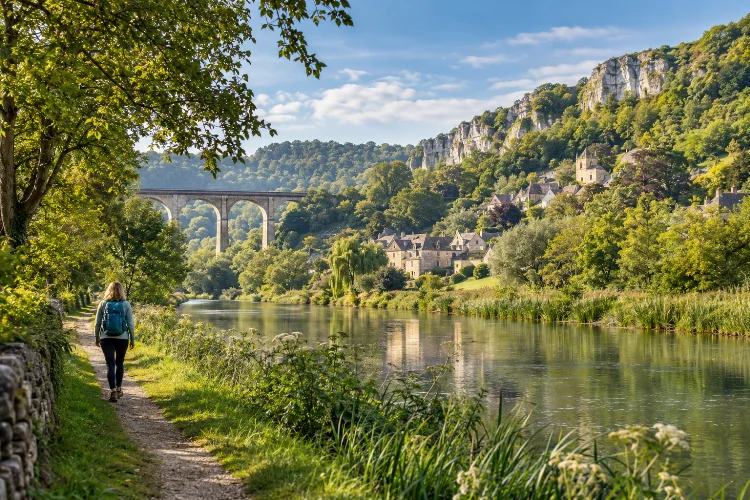
The countryside around Limpley Stoke is made for walking. Within a relatively compact section of the Avon Valley, you can move between quiet riverside paths, wooded slopes, limestone villages, historic canals, railway bridges, and impressive Georgian engineering.
What makes the best scenic walks through the Avon Valley near Limpley Stoke particularly enjoyable is their variety.
One route might follow a nearly level canal towpath beneath mature trees, while another climbs away from the valley floor for broad views over Freshford and the surrounding countryside.
Historic landmarks are never far away either, with Dundas and Avoncliff aqueducts providing memorable stopping points.
The valley is also surprisingly convenient for walkers without a car. Freshford, Avoncliff, Bradford-on-Avon, and Bath are connected by rail, making one-way walks possible without retracing every step.
Visit Bath specifically recommends the Freshford and Avoncliff area for countryside walking and highlights connections with the Kennet & Avon Canal.
For leisurely exploration rather than serious mountain hiking, this is one of the most rewarding landscapes around Bath.
1. Freshford and Limpley Stoke Two Church Circular
For a short introduction to the area, the Two Church Circular is difficult to beat.
The official Cotswolds National Landscape route covers around 2 miles (3.22 km) and normally takes about an hour. Starting around Freshford, it links St Peter’s Church with St Mary’s Church at Limpley Stoke while passing woodland, fields, lanes, and viewpoints across the valley.
Although relatively short, it does not feel like an urban stroll. There are unsurfaced sections, steep steps, field paths, gates, and a steep descent that can become muddy in wet conditions. That mix gives the walk much more countryside character than its modest distance might suggest.
One of the highlights comes around Crowe Lane and Crowe Hill, where walkers can look back across the Limpley Stoke Valley. The route also passes St Mary’s, whose setting on higher ground adds a little historic atmosphere to the walk.
It is an excellent choice if you want scenery without committing half a day.
2. Dundas Aqueduct to Avoncliff Along the Canal
For a longer but easier walk, follow the Kennet & Avon Canal from the Dundas area toward Avoncliff.
Cotswolds National Landscape describes its Brassknocker Basin-to-Avoncliff-and-back route as an easy 6.5-mile (10.46 km) outing taking roughly four hours. The route follows the historic canal and encounters both major aqueducts while staying largely away from road traffic.
The scenery changes gradually rather than dramatically. Narrowboats appear between wooded slopes, the River Avon sometimes becomes visible below, and trains occasionally pass through the same narrow transport corridor.
That combination is part of the attraction. Canal, railway, river, and old roads occupy different levels of essentially the same valley.
The surface is described as stony and bumpy in places, but the route is considerably gentler than the hillside footpaths above Limpley Stoke.
If you want a relaxed half-day walk with almost continuous scenary, this is probably the strongest option.
3. Explore Dundas Aqueduct and Brassknocker Basin
Not every good walk needs to cover a large distance. The area around Dundas Aqueduct works extremely well for a shorter wander.
Completed in the early nineteenth century, Dundas Aqueduct carries the Kennet & Avon Canal over the River Avon. It is both Grade I listed and a Scheduled Monument, and the Canal & River Trust identifies it as one of the significant historic structures along the waterway.
Walking across it gives you a particularly unusual view of the valley because water, rail, and river infrastructure intersect in a remarkably small space.
Continue toward Brassknocker Basin and you can also explore part of the former Somerset Coal Canal. Historic features around Dundas Wharf include a tollhouse, warehouse, and crane, adding industrial heritage to what otherwise feels like a very green countryside walk.
This is a good choice for families or visitors who want plenty to see without covering many miles.
4. Freshford to Avoncliff Beside the River Avon
If your priority is rural scenery rather than canal engineering, try the route between Freshford and Avoncliff.
Visit Bath highlights a countryside walk connecting the two villages beside the River Avon. Both sit within the Limpley Stoke Valley, surrounded by steep wooded hills and patchworks of meadow and pasture.
The atmosphere is noticeably different from the canal towpath. Sections feel more intimate and rural, with riverbank vegetation, grazing fields, traditional houses, and occasional railway views.
Freshford itself makes an appealing starting point because the village rises above the valley and retains plenty of historic character. From Avoncliff, walkers can extend the trip onto the Kennet & Avon Canal rather than returning the same way.
That makes the route especially flexible. You can create a short riverside outing or combine river and canal paths into a longer exploration.
After prolonged rain, however, lower riverside ground can be wetter than the towpath, so sensible footwear is worth bringing.
5. Avoncliff Aqueduct to Bradford-on-Avon
For a walk that ends somewhere with plenty to explore, continue east from Avoncliff toward Bradford-on-Avon.
The starting point alone is impressive. Avoncliff Aqueduct is more than 100 metres long and carries the Kennet & Avon Canal high above the River Avon.
The Canal & River Trust recommends following the waterway from here toward Bradford-on-Avon, passing through the landscape around Barton Farm Country Park.
The route offers classic canal scenery: moored narrowboats, lockside details, tree-lined water, old bridges, and glimpses of the wider valley.
Bradford-on-Avon provides a strong finish because the town’s historical interest extends well beyond the canal. The canal wharf was particularly busy during the nineteenth century, and the town contains landmarks including its medieval tithe barn and historic town bridge.
Because Avoncliff and Bradford-on-Avon both have railway access, this is particulary useful for walkers planning a linear trip rather than a circular one.
6. Walk West From Dundas Toward Bath
The canal does not only lead east toward Avoncliff and Bradford-on-Avon. Heading west gradually takes you toward Bath.
This is a useful option for anyone who enjoys longer, steady-distance walks without major climbs. The Kennet & Avon Canal provides a largely continuous corridor through the countryside before becoming progressively more urban as it approaches Bath.
Visit Bath promotes the canal as a walking connection between Bath and Bradford-on-Avon, passing through the verdant Limpley Stoke Valley along the way. The full journey can take several hours, but there is no need to cover the entire route in a single outing.
Starting around Dundas lets you experience one of the most attractive rural sections.
The changing landscape is arguably the best feature. Quiet woodland and water gradually give way to the outskirts of Bath, making the walk feel like a transition from countryside into city rather than a simple there-and-back trail.
7. Climb Higher for Views Across the Limpley Stoke Valley
The towpath is beautiful, but staying beside the water means missing the valley’s biggest views.
Footpaths and lanes around Freshford, Limpley Stoke, Monkton Combe, and the surrounding slopes allow walkers to climb above the Avon.
From higher ground, the structure of the landscape becomes much clearer: steep green hills surround a narrow corridor carrying the river, railway, roads, and canal.
The Two Church Circular offers a manageable taste of this terrain, including steep sections and views back across the valley. Farther afield, Cotswolds National Landscape routes on surrounding higher ground also highlight distant views toward Limpley Stoke Valley and the Mendips.
These routes require more effort than the canal, especially after wet weather, but the reward is a completely different perspective.
If photography is your priority, try walking early or late in the day. Low light tends to emphasise the valley contours and limestone buildings much better than flat midday sun.
Practical Tips for Walking Around Limpley Stoke
The biggest decision is whether you want an easy towpath walk or a more traditional countryside route.
Canal walks are generally straightforward, although surfaces may still be rough or stony.
Hillside routes can contain steep steps, unsurfaced paths, narrow sections, and mud. The official Two Church Circular specifically recommends suitable footwear and notes that parts become muddy after rain.
Public transport can also make route planning easier. Freshford and Avoncliff provide useful railway access, while Bradford-on-Avon gives longer linear walks a natural endpoint.
Avoid assuming that every tempting track is a public footpath. For longer variations, check an up-to-date rights-of-way or OS map before leaving the marked routes.
And if heavy rain has recently fallen, be prepared to alter a riverside plan. Water levels and muddy paths can make supposedly easy countryside walks considerably less accesible.
The best scenic walks through the Avon Valley near Limpley Stoke combine far more than attractive countryside. Within a single outing you can encounter quiet rivers, historic villages, wooded hills, a Georgian canal, railway infrastructure, and two extraordinary aqueducts.
For an easy introduction, try the Two Church Circular between Freshford and Limpley Stoke. For a longer day, the canal between Dundas and Avoncliff offers gentle terrain and outstanding heritage, while continuing toward Bradford-on-Avon creates an excellent linear journey.
Whichever route you choose, allow time to stop rather than simply chase distance. The Avon Valley rewards slow walking: watch the river, explore the old engineering, look back from the hills, and notice how closely nature and history share the same landscape.
