

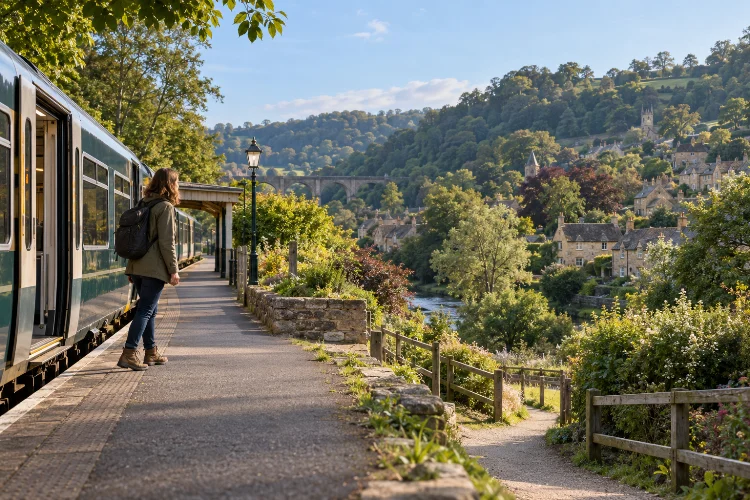
Looking at a railway map of the Avon Valley can be slightly confusing. Trains still run straight through Limpley Stoke, and an old station building survives beside the line, yet you cannot actually buy a ticket to Limpley Stoke today.
For modern travellers, understanding train connections between Freshford and Limpley Stoke starts with one important fact: Freshford is the practical rail gateway for the village.
Limpley Stoke’s passenger station closed in 1966, while Freshford remains an active Great Western Railway station on the route linking Bath with Bradford-on-Avon, Westbury, and destinations farther south and east.
That arrangement is actually quite convenient. Freshford lies within the same Avon Valley landscape, and Bath is only about nine minutes away by train according to Visit Bath.
From Freshford, travellers can continue toward Limpley Stoke by local bus, taxi, or on foot, making rail especially useful for countryside day trips.
Why Limpley Stoke No Longer Has a Passenger Station
Limpley Stoke once had its own railway station.
The station opened in 1857 when the railway between Bradford-on-Avon and Bathampton was completed.
It later became a junction after the extension of the Camerton branch in 1910, with the surrounding rail network carrying passengers, quarry stone, and coal traffic from the Somerset Coalfield.
Passenger use eventually declined, and the main station closed in 1966. The building survives beside the active railway, complete with a reproduction station nameboard, but trains no longer stop there.
That is why journey planners will not show “Limpley Stoke” as a railway destination.
Instead, visitors normally search for Freshford (FFD) and complete the short final section using another form of transport.
The surviving railway can therefore create a slightly misleading impression. You may hear trains passing through Limpley Stoke throughout the day, but the nearest useful boarding point is in neighbouring Freshford.
Freshford Station Is the Main Rail Gateway
Freshford station sits on Station Road and is managed by Great Western Railway. National Rail confirms that it remains an operational station with connections into the wider local rail network.
For visitors coming from Bath, the journey is remarkably short.
Visit Bath describes Freshford as approximately nine minutes from Bath by train, making it one of the easiest rural escapes from the city. It also identifies Freshford and nearby Avoncliff as useful stations for exploring the Limpley Stoke Valley.
Services through the area form part of the local route toward Bradford-on-Avon and Westbury. Depending on the train, journeys may continue farther toward places such as Frome, Salisbury, Weymouth, or Portsmouth.
Not every service passing through the valley necessarily stops at Freshford, though. Always check the specific train rather than assuming every eastbound or westbound service will call there.
Bath Spa to Freshford Is the Most Useful Connection
For most tourists, the key railway connection is Bath Spa to Freshford.
Bath Spa is centrally located and offers good onward connections from Bristol, London, Cardiff, and other major destinations. National Rail also confirms full step-free access at Bath Spa, making it considerably better equipped than smaller rural stations.
Once aboard a stopping service toward the Avon Valley, Freshford is only a short ride away.
That makes the railway attractive for visitors who want to combine a city stay in Bath with a half-day or full-day exploration of Limpley Stoke.
A typical plan might involve taking a morning train from Bath Spa, walking or transferring from Freshford into Limpley Stoke, exploring the village and valley, and returning from Freshford later in the day.
The main practical rule is simple: check both your outbound and return trains before setting off. Rural frequencies are lower than urban commuter services, so missing one train can create a much longer wait than expected.
Connecting From Freshford Station to Limpley Stoke
The railway only completes most of the journey.
From Freshford, one option is local bus 94, operated by Libra Travel. Current Travelwest timetable information shows the route serving Freshford and several Limpley Stoke stops, including Hop Pole Inn, St Mary’s Church, and Midford Lane.
For example, current weekday services travel between Freshford-area stops and Limpley Stoke at several points during the day. However, this is a rural service rather than a frequent city bus, so departures are spaced relatively far apart.
That means train and bus connections do not always line up perfectly.
If your arrival misses the 94, a taxi may be more convenient, particularly if you are carrying luggage.
Walking is another possibility and often the most enjoyable one for visitors travelling light. Freshford and Limpley Stoke are close enough to be linked through countryside paths and village lanes, although the terrain includes hills, uneven surfaces, and potentially muddy sections.
The final connection is therefore easy, but not always completely seamless.
Walking Can Turn the Transfer Into Part of the Trip
For leisure travellers, the gap between station and village can actually be an advantage.
Freshford lies in the Limpley Stoke Valley, surrounded by wooded slopes and countryside paths. Visit Bath specifically recommends the area for walks along the River Avon and onward toward Avoncliff.
Instead of treating Freshford as an inconvenient transfer point, you can make it the beginning of your walk.
One approach is to explore Freshford first and then follow established local footpaths toward Limpley Stoke. The surrounding network allows walkers to combine historic village streets, churches, fields, and elevated valley views.
Allow more time than the straight-line distance suggests.
The landscape is hilly, surfaces can become wet, and the nicest routes are rarely the shortest road connection. Walking boots or trail shoes are a better choice than lightweight city footwear after rain.
For people carrying suitcases, however, this option is much less practical. A bus or pre-arranged taxi will be considerably easier.
Freshford Station Is Small and Has Accessibility Limitations
Freshford is useful, but travellers should not expect the facilities of Bath Spa.
National Rail classifies Freshford as step-free category C, meaning there is no step-free access to the platforms. There are also no lifts, and regular staffed assistance is unavailable at the station.
This is important for wheelchair users, travellers with reduced mobility, or anyone managing heavy luggage.
The station does have sheltered waiting and seating areas, information screens, help points, bicycle storage, and a small car park.
If accessibility is a major concern, planning the journey carefully in advance is worthwhile. Bradford-on-Avon or Bath Spa may offer more suitable facilities depending on the wider itinerary.
The rural nature of the station is part of its charm, but it also means fewer services and less infrastructure than you might expect at a large regional stop.
Avoncliff Can Be a Useful Alternative Station
Freshford is not the only railway option in the valley.
Avoncliff lies farther east and is another small station on the same local line. Visit Bath highlights both Freshford and Avoncliff as rail gateways for exploring the River Avon and surrounding countryside.
Avoncliff becomes particularly useful if your plan involves walking rather than reaching central Limpley Stoke directly.
You could take the train to Freshford, walk through the valley toward Limpley Stoke and Avoncliff, then catch a return train from Avoncliff instead of retracing your route.
This creates a more interesting linear walk.
Avoncliff is also close to the Kennet & Avon Canal and its famous aqueduct, allowing the railway to support a much larger countryside itinerary.
For pure access to Limpley Stoke, Freshford remains the more logical choice. For hiking and canal exploration, however, combining both stations gives you much greater flexiblity.
Check Engineering Work Before Evening Travel
Local trains are usually straightforward, but the Bath–Westbury corridor periodically undergoes engineering work.
National Rail has scheduled replacement buses on several 2026 evenings when late trains between Bath Spa and Westbury or Frome were unable to operate normally. On those occasions, replacement road transport served Freshford Village along with other local communities.
This is why checking live journey information matters, especially for late returns.
Do not assume that the timetable you used during a previous trip will remain unchanged.
Weekend engineering work, signalling problems, or other disruptions can alter stopping patterns. Saving an earlier return option also gives you some protection if the last convenient service is cancelled.
For a countryside day trip, a little extra planning usually prevents the only major source of stress.
A Simple Rail-Based Day Trip Strategy
The easiest itinerary is to start at Bath Spa.
Take a stopping train to Freshford, then either connect with the 94 bus, arrange a taxi, or walk into Limpley Stoke. Spend several hours exploring the village before returning toward Freshford.
More adventurous walkers can continue through the Avon Valley rather than turning back.
Freshford and Avoncliff are only one or two local rail stops out of Bath and are specifically promoted as gateways for countryside exploration.
This makes it possible to arrive at one station and depart from another.
Before leaving Bath, check live train departures, the 94 timetable if you need the bus connection, and the weather if walking forms part of the route.
That small amount of preperation turns what initially looks like an awkward missing-station problem into a very manageable car-free journey.
Understanding train connections between Freshford and Limpley Stoke is straightforward once you realise that modern rail services do not stop in Limpley Stoke itself.
Its historic station closed to passengers in 1966, leaving Freshford as the practical gateway for most rail travellers.
From Bath Spa, the train journey to Freshford takes roughly nine minutes. From there, travellers can continue by route 94, taxi, or countryside footpaths, while Avoncliff offers another useful station for longer walking routes.
The key is to treat the final connection as part of the journey rather than expecting a direct train. Check current rail and bus schedules, consider accessibility needs, and leave some flexibility around return times.
With that planning done, reaching Limpley Stoke by rail is both practical and one of the most scenic ways to experience the Avon Valley.
