

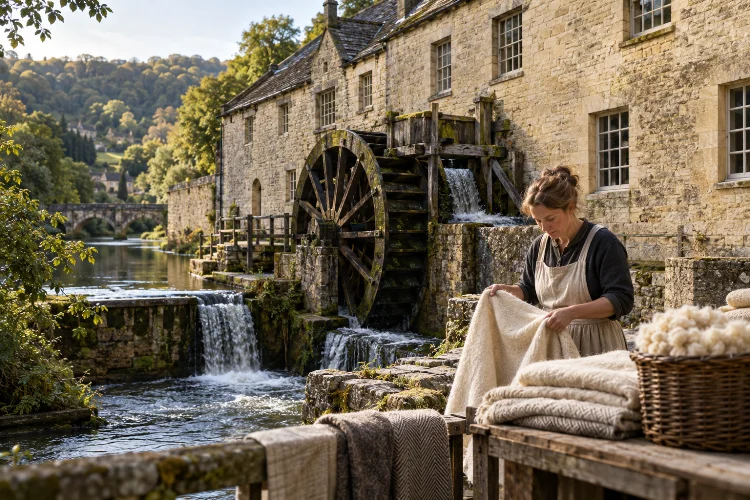
Today, Limpley Stoke feels far removed from the noise and routine of industrial production. Its limestone houses, wooded slopes, and position above the River Avon give the Wiltshire village an unmistakably rural atmosphere.
A few centuries ago, however, water, wool, machinery, and textile workers were central to everyday life.
Understanding how the cloth industry shaped historic life in Limpley Stoke helps explain much more than the story of one old mill.
Textile production influenced where people settled, what kinds of houses appeared, how families earned money, and why shops, inns, workshops, and other local services grew around particular parts of the village.
The River Avon was especially important. Its reliable flow supplied power for fulling cloth long before large factories appeared, eventually supporting a more concentrated form of manufacturing during the Industrial Revolution.
By the early nineteenth century, Limpley Stoke’s cloth factory employed hundreds of people. That industrial past may be less obvious today, but its influence remains embedded in the village’s landscape, buildings, and settlement pattern.
Water Power Made Cloth Production Possible
Before steam engines transformed British manufacturing, flowing water was one of the most valuable sources of industrial energy.
Limpley Stoke had an obvious advantage: the River Avon. By 1376, the local mill was already being used for fulling woollen cloth.
Fulling was an essential finishing process that cleaned newly woven material while making it thicker and more compact. Water-powered machinery could perform this work far more efficiently than manual methods.
The Bradford on Avon Museum records that Adam Toukere held the mill from the Abbess of Shaftesbury at this time. His surname is particularly interesting because “tucker” was another term for a fuller, directly linking its medieval occupier with the textile trade.
The mill was still operating as a fulling mill in 1614. This demonstrates that textile production was not a short-lived experiment but part of Limpley Stoke’s economy across several centuries.
Geography had therefore become economics. The same river that shaped the valley also provided the energy needed to support specialised work.
Cloth Making Helped Create Middle Stoke
The influence of wool went beyond the mill itself.
The original settlement, known as Hanging Stoke, had been badly affected by the Black Death of 1348-49.
During the fifteenth century, a newer settlement gradually developed farther north, with Wiltshire’s community history specifically connecting this expansion to cloth weaving and dependence on the river.
By around 1500, a fulling mill was providing employment and weavers’ cottages had been constructed for textile workers. This newer neighbourhood became what is now known as Middle Stoke.
That makes the cloth trade one of the forces behind the physical geography of modern Limpley Stoke.
People needed homes reasonably close to their work, and other services naturally followed. A bakery, inn, and cider house developed around the newer centre, followed in later periods by a school and village hall.
Rather than simply operating inside one industrial building, textile production effectively helped reorganise the village.
Weaving Connected Homes With the Wider Textile Economy
Early textile production was very different from the later factory system.
Much of the weaving associated with West Country cloth making traditionally took place in domestic workshops. Workers might weave in their homes while processes requiring water power, such as fulling, were concentrated around mills.
This helps explain why weavers’ cottages matter when interpreting Limpley Stoke’s historic landscape.
They represent the household side of an industry that depended on networks of different workers and specialist processes rather than one enormous factory performing everything under a single roof.
Clothiers coordinated these networks. They could arrange supplies of wool, distribute work, organise finishing, and market completed textiles.
The Bradford on Avon area developed into an important woollen manufacturing district, and Limpley Stoke formed part of this broader regional economy.
Surviving documentary collections relating to local woollen production include cloth samples, dye recipes, and records of manufacturing techniques, showing how sophisticated the trade became.
For villagers, that meant supposedly “rural” life was connected to commercial networks extending well beyond the Avon Valley.
The Factory Era Changed the Scale of Employment
The biggest transformation came around the turn of the nineteenth century.
The Limpley Stoke fulling mill was advertised for sale in 1796 and purchased by John Newton. It was subsequently rebuilt as a factory and operated between 1796 and 1822 by Bush, Newton & Bush.
By 1816, around 200 people were employed there.
For a relatively small settlement, that figure is significant. Instead of production being scattered mainly through domestic weaving and small workshops, a substantial number of workers could now depend on one industrial enterprise.
Factory work also imposed different routines. Manufacturing increasingly depended on machinery, shared working spaces, organised hours, and coordinated production rather than the more flexible pattern associated with home-based weaving.
This period probably came closest to making Limpley Stoke an industral village. The rural landscape remained around it, but daily economic life was increasingly organised around large-scale production.
Clothiers Influenced Wealth and Village Development
The textile trade also shaped the social hierarchy of Limpley Stoke.
The Dickes family were prominent local clothiers and landowners. Richard Dickes purchased Limpley Stoke in 1615, while later family members controlled different parts of the settlement. Wiltshire’s local history notes that the family encouraged development toward the river and the mill.
Their connection with properties such as Waterhouse and the wider Stoke Estate illustrates an important side of the textile economy.
Cloth manufacturing could create substantial wealth for successful merchants and entrepreneurs. That money was reflected in landownership, larger houses, employment relationships, and influence over how the village developed.
The contrast between substantial residences and smaller workers’ cottages therefore tells a social story as well as an architectural one.
Textiles did not benefit everyone equally. They created a hierarchy ranging from wealthy clothiers and factory proprietors to skilled craftspeople, labourers, and families whose incomes depended heavily on changing demand for woollen goods.
Innovation Was Part of the Local Textile Story
Historic cloth making was not simply a traditional craft repeated unchanged for generations.
Limpley Stoke was also connected with technological experimentation. Joseph Daniell, who lived in the village, held numerous patents, including inventions associated with textile manufacture.
Wiltshire’s historical record mentions a damp-resistant finish for cloth and spiked rollers designed to keep fabric stretched to its full width while on the loom.
Details such as these reveal how competitive textile manufacturing had become.
Improvements in machinery, finishing, dyeing, and production efficiency could determine whether a business remained profitable. Manufacturers throughout Britain were constantly adapting as industrialisation accelerated.
This technological pressure eventually helped move cloth production away from older systems.
Water power remained useful, but factories elsewhere increasingly adopted more advanced machinery and steam power. Places that failed to modernise efficiently could struggle against larger competitors.
The traditional textile economy was gradually becoming part of a much faster-changing manufactuing world.
The Cloth Trade Supported a Wider Village Economy
A large employer creates demand far beyond its own workforce.
During the nineteenth century, Limpley Stoke supported occupations including tailoring, shoemaking, brewing, grocery trading, carpentry, building, and millinery. These trades were typical of a functioning village economy in which residents purchased goods and services locally.
It would be too simple to claim that every business existed entirely because of cloth manufacturing. Agriculture, quarrying, wealthy households, and later transport links also supported the community.
Still, textile employment created spending power and helped concentrate population around the village.
Religious and social institutions also expanded during the industrial period. Baptists established themselves locally in 1816, while Methodists were recorded from 1829.
The surviving Baptist Chapel in Middle Stoke dates from the early nineteenth century, showing how the growing community developed institutions beyond workplaces and houses.
Industrial history was therefore also social history.
Decline Left Space for New Industries
Limpley Stoke’s textile economy did not remain successful indefinitely.
The factory experienced periods of vacancy between 1826 and 1835. Saunders, Fanner & Company later operated the works but became bankrupt in 1842, after which the building stood empty again before being damaged by fire in 1853.
These disruptions illustrate the instability of nineteenth-century textile manufacturing. Competition, changing technology, access to capital, and shifting markets could quickly damage businesses that had once employed large workforces.
Yet the mill site did not simply disappear.
In 1875, Giles and Willie Holbrow began producing rubber at the former woollen mill. The business was later taken over and ultimately relocated to Melksham, contributing to the company that became the Avon Indiarubber Company.
This transition from wool to rubber is an especially revealing example of industrial adaptation. Infrastructure originally shaped by one industry provided the foundation for another.
The Textile Landscape Is Still Visible Today
Modern Limpley Stoke no longer feels like a manufacturing centre, but traces of its cloth-producing past remain.
Middle Stoke itself is perhaps the biggest surviving clue. Its growth was directly associated with weaving, fulling, and the need for homes near places of employment. Historic cottages still preserve part of that settlement pattern.
Historic England, for example, records surviving early nineteenth-century limestone houses in Middle Stoke, demonstrating how the neighbourhood continued developing during the later years of the textile economy.
The old mill site provides another connection, even though the building has been repeatedly altered and reused.
What appears today as a peaceful village landscape was once filled with the practical relationships between water, workers, cottages, workshops, merchants, and transport.
Seeing those relationships makes Limpley Stoke’s heritage much easier to understand. Its history is not seperated into isolated monuments; it is built into the shape of the village itself.
The story of how the cloth industry shaped historic life in Limpley Stoke reaches far beyond wool and weaving.
Textile production helped move the centre of settlement toward Middle Stoke, created employment, encouraged the construction of workers’ homes, supported local businesses, generated wealth for clothier families, and linked the village with the wider West Country economy.
The industry also changed dramatically over time. Medieval fulling developed into factory production, technological innovation transformed working methods, and nineteenth-century competition eventually contributed to decline. Even then, the former mill found new industral uses.
When exploring Limpley Stoke today, look beyond its rural appearance. Follow Middle Stoke toward the river, notice the surviving cottages, and consider how water once powered an economy. Those details reveal just how strongly cloth helped create the village that survives today.
