

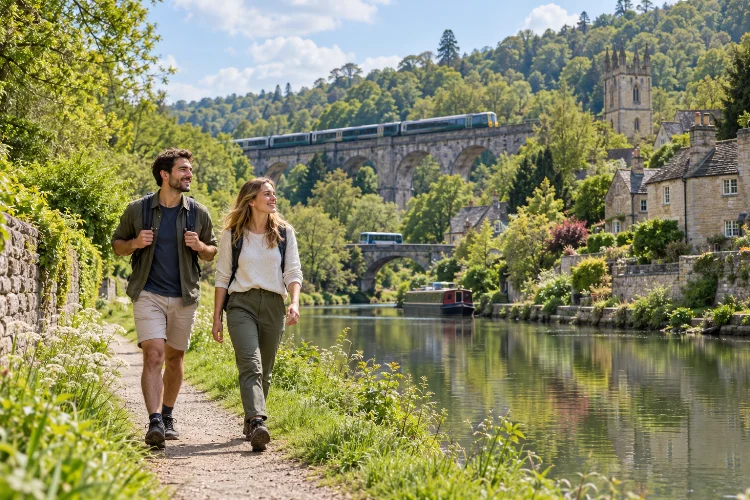
Exploring the English countryside without a car can sound complicated, especially when your destination is a small village rather than a major town. Around Limpley Stoke, however, the geography works surprisingly well in favour of car-free travellers.
The Avon Valley is threaded together by local railway stations, rural bus services, historic footpaths, and the Kennet & Avon Canal.
Freshford and Avoncliff both have rail connections, while Bradford-on-Avon sits only a few stops farther along the same line. Limpley Stoke itself no longer has an active passenger station, but it can be reached by bus or on foot from nearby Freshford.
Knowing how to explore Limpley Stoke and nearby villages without a car is therefore less about finding one perfect transport service and more about combining several simple options.
Take the train for longer hops, use local buses when the timing works, and walk between neighbouring villages when the weather is good. With a little preperation, the absence of a car can actually make the Avon Valley more enjoyable.
Use Freshford as Your Main Gateway to Limpley Stoke
Freshford is the most practical railway gateway for reaching Limpley Stoke.
The village is served by trains on the Bath–Bradford-on-Avon–Westbury corridor. Visit Bath specifically recommends Freshford and Avoncliff as rail-accessible bases for exploring the Limpley Stoke Valley, with both villages only a short journey from Bath.
Once you arrive in Freshford, you have several choices.
Local bus 94 connects Freshford with stops inside Limpley Stoke, including St Mary’s Church, Hop Pole Inn, and Midford Lane. Current timetable information shows daytime journeys at intervals rather than the frequent service you would expect in a city.
If the bus timing is inconvenient, walking can be more attractive anyway.
Freshford and Limpley Stoke are linked by countryside paths, including the official Two Church Circular. This 2-mile route connects St Peter’s Church in Freshford with St Mary’s in Limpley Stoke, with around 95 metres of ascent and descent.
Walk Between Limpley Stoke and Freshford
Walking is arguably the best way to experience these two neighbouring villages.
The Two Church Circular passes fields, woodland, Crowe Lane, Crowe Hill, and sections near the River Frome. The route takes about an hour without long stops, although photography, muddy ground, or a café break can easily stretch it longer.
This is not a completely flat village stroll.
There are unsurfaced sections and some steeper terrain, particularly around the approach to St Mary’s. After wet weather, good walking shoes are more useful than casual trainers.
The advantage is that the journey itself becomes part of the sightseeing.
Instead of getting off a bus, photographing Limpley Stoke, and leaving again, you gradually experience how the two settlements sit within the same valley landscape.
For car-free travellers, that is a major benefit. A transport gap becomes a scenic walk.
Take the Train to Avoncliff for a Different Valley Experience
After Freshford and Limpley Stoke, Avoncliff is an easy next destination.
Visit Bath describes Freshford and Avoncliff as one or two stops outside Bath on the local rail route and recommends walking between them beside the River Avon.
Avoncliff is especially useful because its station sits close to the Kennet & Avon Canal.
The main landmark is Avoncliff Aqueduct, a Grade II listed structure more than 100 metres long that carries the canal high above the River Avon. The railway station is immediately nearby, making it unusually accesible for travellers without a car.
From here, you can decide whether to keep walking or catch another train.
The canal path runs east toward Bradford-on-Avon and west toward Dundas and Bath. That gives you a ready-made, traffic-free corridor without needing complicated navigation.
It also makes Avoncliff one of the best places to build a linear walking day.
Continue to Bradford-on-Avon by Train or Towpath
Bradford-on-Avon is the easiest larger destination to add to the trip.
Visit Bath reports that trains between Bath Spa and Bradford-on-Avon run roughly twice an hour, while Bradford is just a couple of rail stops beyond Freshford and one beyond Avoncliff.
That means you can travel there quickly when your legs need a break.
Alternatively, walk from Avoncliff along the Kennet & Avon Canal. The Canal & River Trust notes that following the waterway east from Avoncliff leads through the countryside toward Bradford-on-Avon and Barton Farm.
The town itself rewards a slower visit.
Its River Avon setting, canal, medieval Tithe Barn area, historic streets, cafés, and old bridge make it substantially more than a transport interchange. Visit Bath also promotes Bradford-on-Avon as a straightforward car-free excursion from Bath.
For a particularly good day, arrive in Freshford, walk through Limpley Stoke and Avoncliff, then finish in Bradford and return by train.
Use Local Buses Strategically Rather Than Constantly
Buses are useful around Limpley Stoke, but they work best as part of the plan rather than the entire plan.
Route 94 currently serves locations including Bathampton, Limpley Stoke, Freshford, and surrounding communities. In Limpley Stoke, stops include the Viaduct Hotel, Hop Pole Inn, St Mary’s Church, and Midford Lane depending on the journey.
Because this is a rural route, departures are not continuous.
That means it is worth checking the timetable before starting a walk rather than arriving at a stop and hoping something appears soon.
The wider D1 corridor also provides useful connections between Bath, Bradford-on-Avon, Trowbridge, Westbury, and Warminster, although current First Bus timetables show that not every D1 variation serves exactly the same stops.
Use trains for predictable longer journeys and buses for specific village connections. That combination is usually far more convienient than trying to force every journey onto one mode of transport.
Make the Kennet & Avon Canal Your Car-Free Highway
One of the biggest advantages of this region is the Kennet & Avon Canal.
The towpath links Bath with the Avon Valley and Bradford-on-Avon, meaning walkers and cyclists have an almost continuous route through countryside that would otherwise require several road journeys.
Visit Bath estimates that walking the canal route between Bath and Bradford-on-Avon takes roughly four to six hours, passing through the Limpley Stoke Valley along the way.
You obviously do not need to walk the entire distance.
Use the railway to shorten it. Take a train from Bath to Freshford or Avoncliff, walk a section of the valley, and catch another train home from Bradford-on-Avon.
This approach is particularly good if you dislike circular walks.
Instead of doubling back, every mile takes you somewhere new, while the train effectively acts as your return transport.
Build a One-Day Car-Free Village Itinerary
A realistic day can begin at Bath Spa station.
Take a morning train to Freshford, then explore the village before following the footpaths toward Limpley Stoke. The Two Church Circular gives you a clear route while adding woodland, fields, and valley views.
Spend some time around Limpley Stoke’s lanes and St Mary’s before returning toward Freshford or extending the walk through the valley.
From there, continue toward Avoncliff, either on foot or by rail.
Stop at the aqueduct, join the canal towpath, and finish in Bradford-on-Avon. Once you have explored the town and had something to eat, catch a direct train back toward Bath.
The beauty of this itinerary is flexibility.
If the weather deteriorates, shorten the walk and use the railway. If conditions are perfect, keep walking.
Public transport becomes a safety net rather than a limitation.
Plan Around Weather and Rural Terrain
Car-free travel works best when you accept that countryside conditions can change your plan.
Cotswolds National Landscape warns that sections of the Freshford–Limpley Stoke walk are unsurfaced and can become muddy. The River Frome area can also be affected by wet conditions.
Carry a lightweight waterproof and shoes with reasonable grip.
Also remember that rural stations are small. Freshford and Avoncliff are useful because of their location, not because they have extensive facilities.
Keep your phone charged and save relevant train times before beginning longer walks.
It is especially important to check evening services. National Rail has scheduled several periods of engineering work on the Bath–Westbury corridor during 2026, with some late trains replaced by buses serving Freshford village and Westwood for Avoncliff.
The lesson is simple: check live travel information rather than depending completely on a timetable saved months earlier.
Avoid Trying to See Every Village in One Day
Travelling without a car encourages slower exploration, and that is a good thing.
Limpley Stoke, Freshford, Avoncliff, and Bradford-on-Avon can technically be connected within one long day, but you do not need to rush through all of them.
For a relaxed first day, concentrate on Freshford and Limpley Stoke.
On another day, take the train to Avoncliff and walk the canal toward Bradford-on-Avon. Visit Bath specifically recommends this corridor for car-free countryside exploration, with rail stations allowing visitors to mix hiking and train travel.
Separating the routes gives you time to enjoy churches, cafés, river views, aqueducts, and historic streets rather than constantly watching the clock.
It also reduces dependence on perfectly timed connections.
Car-free travel becomes much easier when your itinerary has breathing room.
Learning how to explore Limpley Stoke and nearby villages without a car is mostly about combining the right forms of transport.
Freshford works as the main rail gateway for Limpley Stoke, local bus 94 fills some shorter gaps, and walking connects villages that are close enough to explore naturally on foot.
Avoncliff adds another useful railway station and access to the Kennet & Avon Canal, while Bradford-on-Avon provides an ideal endpoint for longer linear walks.
Rather than viewing public transport as a compromise, use it to create routes that would actually be awkward with a parked car. Arrive at one station, walk through the valley, and leave from another.
Check live timetables, pack for rural conditions, and keep the schedule flexible. In this part of the Avon Valley, travelling without a car can easily become the better way to explore.
