

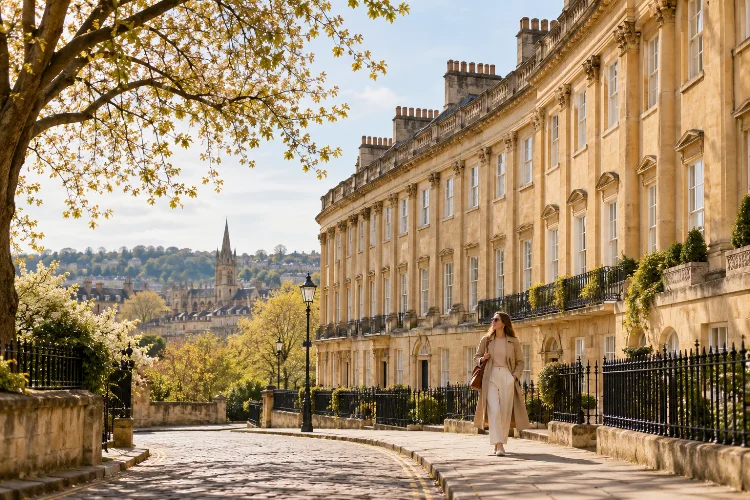
Bath is famous for its honey-coloured terraces, sweeping crescents, symmetrical squares, and elegant eighteenth-century streets. Yet you do not necessarily need to stay among them to appreciate the city’s architecture properly.
Using Limpley Stoke as a countryside base creates an appealing contrast. Mornings can begin among wooded slopes, stone cottages, and quiet Avon Valley scenery before you head into Bath for several hours of architectural exploration.
Nearby Freshford is around nine minutes from Bath by train according to Visit Bath, making the rural-to-city transition surprisingly easy.
Exploring Bath’s Georgian architecture from a rural Limpley Stoke base also changes the way you see the city. Bath’s planners deliberately connected architecture with surrounding landscape, rather than designing individual monuments in isolation.
UNESCO considers that integration of crescents, terraces, squares, hills, and green space central to Bath’s World Heritage significance. That makes a valley stay especially fitting: you experience the countryside that helps explain why Georgian Bath looks the way it does.
Why Limpley Stoke Works as a Base for Georgian Bath
The obvious advantage is having two very different environments within the same trip.
Limpley Stoke feels rural, steep, and organic. Buildings follow the contours of the Avon Valley, while trees, lanes, and older stone structures create a landscape that developed gradually over centuries.
Bath offers almost the opposite experience. Eighteenth-century architects used local Bath stone to create carefully ordered façades, monumental terraces, and planned urban spaces.
The connection is still practical. Freshford, which sits in the Limpley Stoke Valley, is approximately 15 minutes from central Bath by car and around nine minutes by train according to current Visit Bath information.
Rather than spending every night in the city, you can explore Bath during the day and return to countryside surroundings afterward. Always check live rail timetables before relying on a specific service.
Understand the Georgian Vision Before You Start Walking
Bath’s Georgian architecture makes more sense when you realise it was never simply about attractive individual houses.
During the eighteenth century, figures including John Wood the Elder, John Wood the Younger, entrepreneur Ralph Allen, and social organiser Richard “Beau” Nash helped transform Bath into an internationally fashionable spa city.
Visit Bath notes that this period completely reshaped the city’s architecture and society.
UNESCO goes further, highlighting the way Palladian ideas were adapted across an entire city rather than just a few landmark buildings. Squares, terraces, crescents, public rooms, and surrounding hills were designed to work together.
Bath Stone played an important role too. The local oolitic limestone gives Georgian buildings their recognisable warm, honey-coloured appearance.
So when exploring Bath, avoid simply photographing façades. Look at how streets open into squares, how hills frame terraces, and how green spaces appear between formal architecture.
Begin With Queen Square and the Work of John Wood the Elder
A useful architectural walk begins around Queen Square.
John Wood the Elder was responsible for Queen Square during the early Georgian transformation of Bath. From here, the city’s increasingly ambitious planning becomes easy to follow toward Gay Street and The Circus.
Queen Square may initially feel less dramatic than Royal Crescent, but that is partly why it works well as a starting point.
Notice the proportion of the façades, repeated sash windows, classical details, and use of Bath stone. Georgian architecture depended heavily on visual order, even where individual houses behind the façades could differ considerably.
Walking uphill also gradually changes the relationship between architecture and terrain. Bath is built within a valley surrounded by hills, and UNESCO specifically identifies this integration of city and landscape as one of its defining characteristics.
Rather than jumping straight to the famous landmarks, following this progression makes the architectural story much easier to understand.
Study The Circus as an Urban Composition
From Queen Square, continue toward The Circus.
Designed by John Wood the Elder, The Circus is one of Bath’s most recognisable pieces of urban architecture.
Its curving façades create a circular public space rather than a conventional straight Georgian street. Visit Bath identifies it as one of the city’s signature architectural landmarks.
Walk around it instead of viewing it from a single point.
The rhythm of windows, classical orders, stonework, and curved terraces changes as you move. Standing near the centre also makes the scale far easier to appreciate.
From here, Brock Street provides the natural connection toward Royal Crescent. This relationship is important: Bath’s Georgian spaces were designed to flow into one another rather than exist as isolated showpieces.
For travellers coming from Limpley Stoke, the contrast is particularly striking. The morning’s irregular rural lanes are replaced by deliberate geometry, yet both environments remain strongly shaped by surrounding topography.
Give the Royal Crescent More Than a Photo Stop
Royal Crescent deserves time rather than a five-minute photograph.
Designed by John Wood the Younger and constructed between 1767 and 1775, the famous curve consists of 30 Grade I listed houses facing an expansive lawn and Royal Victoria Park.
Its façade demonstrates several Georgian priorities: symmetry, classical proportion, repetition, and controlled visual unity.
The really interesting detail is that the harmony is partly an illusion. Builders had to follow the architectural design of the main façade, while individual houses behind it could be arranged differently. That explains why the backs of the properties are much less uniform.
The Crescent’s original setting also deliberately borrowed from rural estate design. No.1 Royal Crescent explains that its location once gave wealthy residents the impression of looking toward open countryside while living at the fashionable edge of Bath.
That makes staying in rural Limpley Stoke unexpectedly relevant. You arrive from genuine countryside and then see how Georgian architects attempted to bring landscape into urban living.
Go Inside No.1 Royal Crescent to Understand Georgian Life
Architecture becomes more meaningful once you understand how people actually used it.
No.1 Royal Crescent was built between 1767 and 1772 and was the first completed house in the development. Today it operates as a historic house museum interpreting Georgian domestic life.
Inside, the neat exterior gives way to a much more complicated social world.
Formal rooms demonstrate how wealthy visitors entertained and presented themselves, while service spaces reveal the work required to maintain that lifestyle. The museum deliberately interprets both affluent occupants and household servants.
This helps prevent Georgian Bath from becoming little more than beautiful stone façades.
Architecture reflected social hierarchy, fashionable behaviour, entertainment, wealth, and Bath’s role as a destination where visitors came to socialise as much as to take the thermal waters.
Allowing roughly an hour here can add considerably more context than trying to visit several smaller attractions in quick succession.
Walk Through Gravel Walk and Notice Landscape Design
After Royal Crescent, take some time away from traffic and formal streets.
Gravel Walk connects the Royal Crescent area toward Queen Square and has existed since the Georgian period. Visit Bath notes that the walkway was created in 1771 and became a route associated with promenading and sedan-chair travel.
Nearby, the Georgian Garden provides a smaller example of period landscape design.
The garden behind 4 The Circus has been reconstructed according to a layout dating from around 1760-1770. Archaeological excavation in the 1980s helped locate original paths, planting beds, and trellis positions.
These quieter spaces matter because Georgian Bath was designed around much more than buildings.
Promenading, seeing other people, being seen, and enjoying controlled views of greenery were all part of fashionable city life. This relationship between architecture and landscape is one reason Bath’s Georgian neigbourhoods still feel unusually spacious.
Cross Pulteney Bridge and Explore Great Pulteney Street
For a different Georgian district, return toward the River Avon and Pulteney Bridge.
Robert Adam designed the bridge in 1769 as part of plans to develop Bath eastward. Its defining feature is the line of shops spanning both sides of the bridge, making it one of Bath’s most distinctive eighteenth-century structures.
Cross it and continue through Laura Place into Great Pulteney Street.
Completed in 1789 and designed by Thomas Baldwin, the street extends for more than 1,000 feet and is around 100 feet wide. Visit Bath describes it as the city’s widest and grandest thoroughfare.
This is architecture designed for movement and spectacle.
The broad perspective leads toward the Holburne Museum, creating a long urban vista rather than a single monumental façade. Walking the entire street lets you experience the scale in a way photographs cannot.
It is also a good reminder that Georgian Bath continued evolving beyond the work of the Wood family.
Use the Rural Base to Avoid Architectural Overload
Bath contains around 5,000 listed buildings, so trying to inspect everything in one visit is unrealistic.
A rural base makes it easier to divide architectural exploration across several days.
On the first day, focus on Queen Square, The Circus, Royal Crescent, and No.1 Royal Crescent. On another, explore Pulteney Bridge, Great Pulteney Street, the Holburne area, and perhaps the landscaped spaces surrounding the city.
Returning to Limpley Stoke between visits gives your eyes a break from continuous façades and urban detail.
It also makes Bath’s design easier to appreciate. UNESCO emphasises that the Georgian city deliberately draws surrounding countryside visually into its urban spaces. After spending time in the Avon Valley, that relationship becomes much easier to recognise.
The city and countryside are not really seperate experiences. They help explain each other.
Exploring Bath’s Georgian architecture from a rural Limpley Stoke base creates a more balanced way to experience one of Britain’s great historic cities.
Start with Queen Square and The Circus, slow down at Royal Crescent, explore Georgian domestic life inside No.1, then cross the Avon toward Pulteney Bridge and Great Pulteney Street.
The real advantage of Limpley Stoke is not simply escaping Bath’s busier centre. Its Avon Valley setting helps you understand the Georgian ambition to combine architecture, landscape, and elegant urban life.
Rather than trying to see every façade in one exhausting day, divide Bath into manageable architectural walks and return to the countryside between them.
Check current rail services, wear comfortable shoes, and give the streets time to unfold. Georgian Bath is best appreciated as a complete landscape, not a collection of photo stops.
