

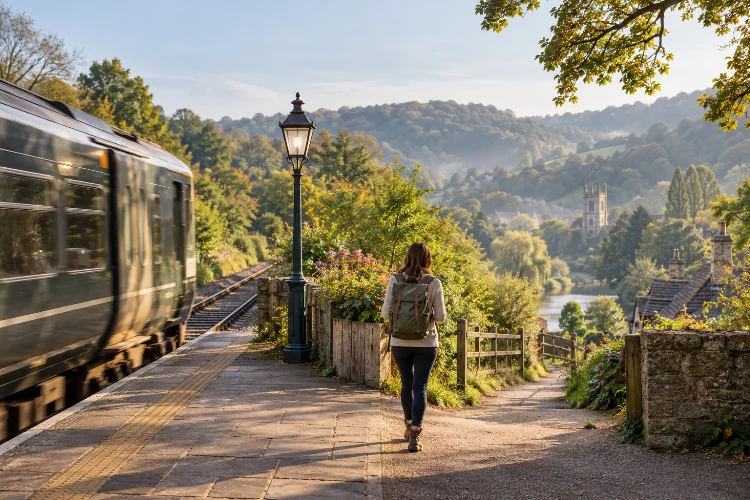
Limpley Stoke may have trains running through its valley, but there is one small complication for visitors: they no longer stop in the village.
Limpley Stoke’s own passenger station closed in 1966, leaving neighbouring Freshford as the most practical railway gateway for many modern trips.
That makes understanding how Freshford Station fits into a Limpley Stoke travel itinerary surprisingly useful. Rather than seeing Freshford as an inconvenient transfer point, think of it as part of the experience.
The station places you within the same attractive Avon Valley landscape, close to countryside footpaths, village lanes, the River Avon, and onward routes toward Avoncliff and Bradford-on-Avon.
It also connects the countryside with Bath remarkably efficiently. Visit Bath currently describes Freshford as just nine minutes from Bath by train.
For walkers, weekend visitors, and travellers staying outside Bath, Freshford can therefore become the transport anchor that makes an entire car-free itinerary work.
Why Freshford Has Become Limpley Stoke’s Rail Gateway
Limpley Stoke once had its own railway station, so Freshford’s modern role makes more sense with a little history.
The former Limpley Stoke station opened in 1857 when the railway connection between Bradford-on-Avon and Bathampton was completed.
It later became a junction for the Camerton branch and handled freight including locally quarried building stone and Somerset coal. Passenger services at the main station ended in 1966.
The railway itself survived, which creates an unusual situation today. Trains continue through the Limpley Stoke Valley, but passengers wanting to visit the village generally use Freshford instead.
Freshford station is currently managed by Great Western Railway and has the station code FFD.
Geographically, this is hardly a major detour. Freshford and Limpley Stoke are neighbouring communities, and local walking routes directly connect them.
In practical terms, Freshford has effectively inherited the role of local rail access without being inside Limpley Stoke itself.
Use Freshford for Fast Access From Bath
For most visitors, the strongest reason to use Freshford is the easy link with Bath.
Current Great Western Railway timetables include Freshford on the corridor running through Bath Spa toward Bradford-on-Avon, Westbury, and destinations farther south. GWR’s current timetable period runs from 17 May to 12 December 2026.
Visit Bath describes the Bath–Freshford trip as around nine minutes by train.
That makes a simple morning itinerary possible. Stay in Bath, catch a local train to Freshford, and within minutes you exchange Georgian streets for wooded slopes and village countryside.
The reverse works equally well.
If you are staying around Limpley Stoke, Freshford provides a practical route into Bath for museums, restaurants, shopping, or an evening in the city without needing to drive into the centre.
Not every train travelling along the line necessarily stops at Freshford, so check the specific service rather than simply turning up and boarding the next train heading in the right direction.
Turn the Station-to-Village Connection Into a Walk
For walkers, Freshford Station does more than solve a transportation problem. It gives you a natural starting point.
Cotswolds National Landscape publishes the Two Church Circular, a roughly 2-mile or 3.22-kilometre walk linking Freshford and Limpley Stoke. The official route takes about an hour and includes approximately 95 metres of ascent and descent.
From Freshford, the route passes St Peter’s Church, woodland, open fields, Crowe Lane, and Crowe Hill before climbing toward St Mary’s Church in Limpley Stoke.
This makes a far more memorable arrival than taking transport directly to your final destination.
You gradually see the Limpley Stoke Valley open around you, while the climb explains how the two villages relate to the surrounding terrain.
There is one catch: it is genuine countryside walking. The official guidance notes unsurfaced paths, steep sections, and mud after wet weather.
If you are carrying suitcases rather than a daypack, save this option for later.
Use Route 94 When You Do Not Want to Walk
Freshford Station can also work alongside the local bus network.
Route 94, operated by Libra Travel, connects Freshford with Limpley Stoke and Bath. Current October 2026 timetable data shows stops in Limpley Stoke including Midford Lane, St Mary’s Church, and Hop Pole Inn.
During much of the daytime, services run at widely spaced intervals rather than continuously. For example, current weekday journeys from the Freshford area toward Limpley Stoke appear roughly every two hours through much of the middle of the day.
That makes the bus useful but not something to approach casually.
Check the timetable before your train reaches Freshford. If the connection works, it can save an uphill walk and bring you closer to historic areas around St Mary’s.
If it does not, consider a taxi or simply enjoy the walk.
Combining rail and bus is often more convienient than trying to make one mode handle the entire journey.
Freshford Works Well for Linear Walking Itineraries
One of the biggest advantages of having an active station in Freshford is that you do not need to finish every walk where you started.
Visit Bath recommends both Freshford and Avoncliff as rail gateways for exploring the Limpley Stoke Valley. It specifically suggests walking through countryside along the River Avon between the two villages.
That opens up several good itineraries.
You could take the train to Freshford, walk to Limpley Stoke in the morning, return through the valley, and continue toward Avoncliff. From Avoncliff, either catch a train home or join the Kennet & Avon Canal.
Alternatively, start at Avoncliff and finish at Freshford after walking west beside the river.
This style of travel is ideal if you dislike repetitive circular routes.
The railway becomes your return transport, leaving you free to spend the day moving continuously through new scenery rather than worrying about reaching a parked car.
Add Avoncliff and Bradford-on-Avon to a Longer Trip
Freshford also functions as a stepping stone into the wider Avon Valley.
Visit Bath describes Freshford and Avoncliff as just one or two stops from Bath and notes that Bradford-on-Avon is two rail stops beyond Freshford and one beyond Avoncliff.
That gives travellers several ways to extend a Limpley Stoke stay.
Spend one day exploring Limpley Stoke and Freshford. On another, take the train toward Avoncliff, visit its aqueduct, and follow the Kennet & Avon Canal toward Bradford-on-Avon.
A longer hiking itineray can combine all four places, using stations strategically whenever weather or tired legs make walking less appealing.
This is arguably where Freshford becomes most valuable.
It is not simply the “station for Limpley Stoke.” It belongs to a chain of small railway access points that lets visitors explore a substantial stretch of countryside without a car.
Know What Facilities to Expect at Freshford
Freshford is a rural station, not a miniature Bath Spa.
National Rail currently lists sheltered waiting and seating areas, customer information screens, help points, CCTV, bicycle storage, and a small car park with 13 spaces. It does not have public Wi-Fi or refreshments at the station.
Accessibility requires particular attention.
Freshford is classified as step-free category C, meaning there is no step-free access to its platforms. There are no lifts, and staff assistance is unavailable at the station throughout the week.
That may significantly affect travellers using wheelchairs, those with reduced mobility, or anyone handling substantial luggage.
In those situations, a direct bus or taxi connection from Bath may be easier than using Freshford purely because it appears closest on the rail map.
Good travel planning considers the final 500 metres as carefully as the main train journey.
Build Freshford Into a Relaxed Day Rather Than a Tight Connection
A useful itinerary leaves room for Freshford itself.
The village is not merely somewhere to change transport. It sits in the Limpley Stoke Valley and works as a base for walking toward the River Avon, Avoncliff, and the surrounding hills. Visit Bath specifically describes it as an ideal starting point for countryside routes.
Instead of scheduling a train arrival five minutes before a bus, give yourself some breathing room.
Walk through the village, stop for food when facilities are open, or start part of the Two Church Circular while waiting for your next connection.
This approach is especially valuable because rural buses can be infrequent.
It also protects your day from small train delays. A missed connection becomes an extra hour in Freshford rather than a travel disaster.
That little bit of preperation makes rural public transport much less stressful.
Always Check the Live Timetable Before Travelling
Freshford’s basic role is stable, but train times are not.
GWR periodically updates its scheduled timetables and recommends checking live journey information before departure. Engineering work can also lead to altered services or rail-replacement buses.
The same applies to route 94.
Its timetable was revised during 2026, with the current registered variation taking effect from 30 August.
For that reason, use an article like this to understand the strategy rather than treating individual departure times as permanent.
Check the train, check your return option, and then check any connecting bus.
It only takes a few minutes and gives you much more freedom once you start walking.
Understanding how Freshford Station fits into a Limpley Stoke travel itinerary makes exploring the Avon Valley far easier.
With Limpley Stoke’s historic station closed, Freshford now provides the most practical nearby rail access, particularly for visitors travelling from Bath.
Its usefulness goes beyond transportation. From the station, you can connect with route 94, walk directly into Limpley Stoke, follow countryside trails toward Avoncliff, or use the railway to build longer one-way adventures toward Bradford-on-Avon.
The best strategy is to treat Freshford as part of the destination rather than merely a transfer point.
Check live schedules, allow extra time between rural connections, and pack suitable walking shoes. Once you do that, this small station becomes the key to an unusually flexible and car-free Avon Valley itinerary.
